Introduction
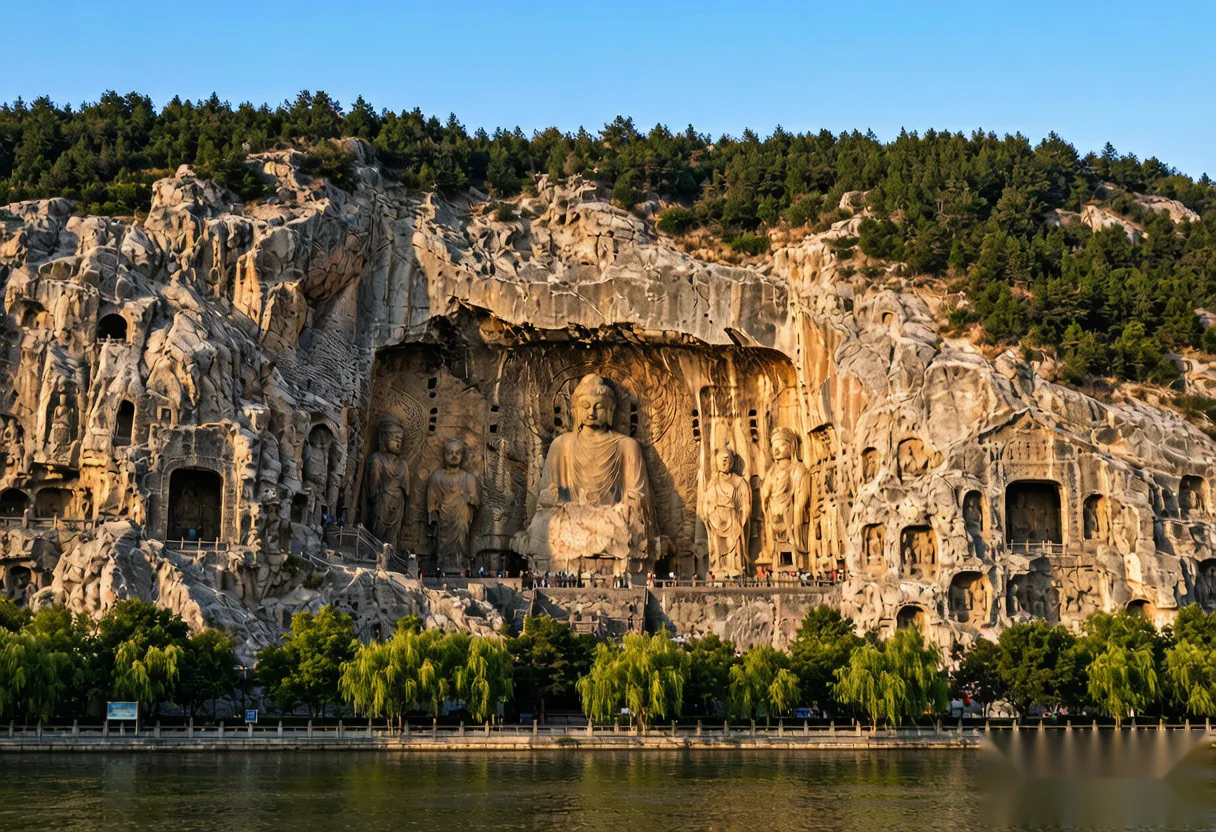
The Longmen Grottoes are the result of one of the most extraordinary building campaigns in Chinese history: nearly four centuries of continuous carving, on the orders of emperors, empresses, court officials and wealthy donors, into the limestone cliffs where the Yi River cuts through the hills south of Luoyang. Understanding the story behind the statues transforms a visit from a walk past beautiful carvings into a walk through the history of imperial China.
The Northern Wei — why it all began
The story starts in 493 AD, when the Northern Wei emperor Xiaowen made a decision that changed everything: he moved his capital from Pingcheng (modern Datong, where the Yungang Grottoes had just been carved) to Luoyang, the city that had served as the capital of the Han dynasty centuries earlier. Moving the court meant moving the court’s religion. Buddhism was the dominant faith of the ruling elite, and carving Buddhist images in stone was both an act of devotion and a way of showing imperial power.
The earliest caves at Longmen — most of them on the West Hill (Xishan) — date from this period. They show the refined, elongated figures typical of Northern Wei art, heavily influenced by the Indian and Central Asian styles that had travelled the Silk Road. The Guyang and Binyang caves are the best-known of this first generation.
The Tang dynasty — the golden age
The second great wave of carving came under the Tang dynasty (618–907), and it produced the site’s masterpieces. By now Buddhist sculpture in China had developed its own fuller, more naturalistic style, and the Tang court had both the money and the piety to sponsor enormous projects.
The centrepiece is the Fengxian Temple niche, completed around 675 AD under the empress Wu Zetian — the only woman in Chinese history to rule as emperor in her own right. Its main figure, the 17-metre-high Vairocana Buddha, sits calm and monumental at the heart of the site. Court tradition holds that the face was modelled to resemble the empress herself. Around it stand attendants, guardian kings and disciples, together one of the greatest groups of Buddhist sculpture in the world.
Most of what you see at Longmen today — roughly two-thirds of the caves and niches — was carved during the Tang period, a remarkable concentration of work in a single era.
What was actually carved
Figures vary from a few centimetres to the giant Vairocana. UNESCO’s figures for the site as a whole are commonly given as more than 2,300 caves and niches, around 100,000 statues, and over 2,800 stone inscriptions — one of the largest collections of stone inscriptions from the age. Much of that inscription material is the “Longmen calligraphy” prized by scholars of Chinese art: the finest stele texts are considered classics of the calligrapher’s art.
Later centuries — repair, loss and the modern era
Carving on a grand scale faded after the Tang. Song and later dynasties carried out repairs and added some smaller works, but the great age was over. The centuries that followed were less kind: stone weathering ate into the soft limestone, and from the late 19th and 20th centuries onwards a trade in antiquities saw many heads and figures hacked from the walls and smuggled abroad. Walking the site today, you will see many headless or damaged statues — losses that are now part of the site’s story, and a reminder of why heritage protection matters.
In 2000, the Longmen Grottoes were inscribed on the UNESCO World Heritage List, recognised for their outstanding contribution to Buddhist art and to the culture of East Asia. Since then the site has been managed as a protected heritage area, with the modern visitor facilities you see today.
Seeing the history on the ground
The two hills are in effect two chapters of the story. Spend your first hour on the West Hill with the Northern Wei caves and the great Tang niches (Fengxian Temple in particular), then cross the bridge to the East Hill for quieter Tang caves and the view back across the river to the West Hill cliff-face. For practical planning — tickets, hours, how long you need — see our visiting guide. For how the site fits into Luoyang’s broader history, read about Buddhism in Luoyang and the Tang dynasty era.